


Many people prescribed opioid medications for pain relief wonder about the difference between Vicodin and Percocet. Both are prescription opioids used to treat moderate to severe pain, whether from surgery, injury, or chronic conditions. They can be effective for short-term pain management, but they also come with serious risks, including opioid dependence, withdrawal symptoms, and overdose when misused.
Both Vicodin and Percocet act on the central nervous system to block pain signals, but they also affect mood and breathing, increasing the risk of addiction over time. Recognizing how these medications work, and how easily misuse can occur, can help people make safer, more informed decisions.
Here at Red Ribbon Recovery Colorado, we provide education and support for individuals and families seeking to understand the risks of prescription opioids and their role in long-term health and recovery.
What are Vicodin and Percocet
When comparing the difference between Vicodin and Percocet, it helps to start with what these medications actually are. Both belong to the class of opioid drugs, and both are combined with acetaminophen, a common pain reliever.
Vicodin for acute pain
Vicodin is a prescription pain medication that combines hydrocodone, a semi-synthetic opioid, with acetaminophen. Doctors may prescribe it for acute pain following surgery or injury, as well as for chronic pain when other medicines are not enough.
Percocet
Percocet is a prescription opioid that combines oxycodone, another semi-synthetic opioid, with acetaminophen. Only oxycodone is considered more potent than hydrocodone, and for that reason, Percocet may sometimes be prescribed for severe pain or cancer-related pain.
How these opioid pain relievers work
Both Vicodin and Percocet act on the central nervous system by binding to specific opioid receptors in the brain and spinal cord. This blocks pain signals for people experiencing moderate to severe pain. At the same time, these medications can also slow breathing, lower blood pressure, and affect mood, which increases the risk of opioid dependence and opioid overdose.
Even though both Vicodin and Percocet are opioid pain medications, their differences in ingredients and potency can impact how doctors prescribe them and how patients respond.
Comparing Vicodin and Percocet
When looking at the difference between Vicodin and Percocet, it becomes clear that the two drugs have many similarities, but also some crucial differences. Both are prescription opioids combined with acetaminophen, and both are used to relieve pain, but both carry the risk of opioid overdose, opioid withdrawal, and opioid addiction.
The strength of their active ingredients and the way they are prescribed can make a difference in how they are used.
Key differences
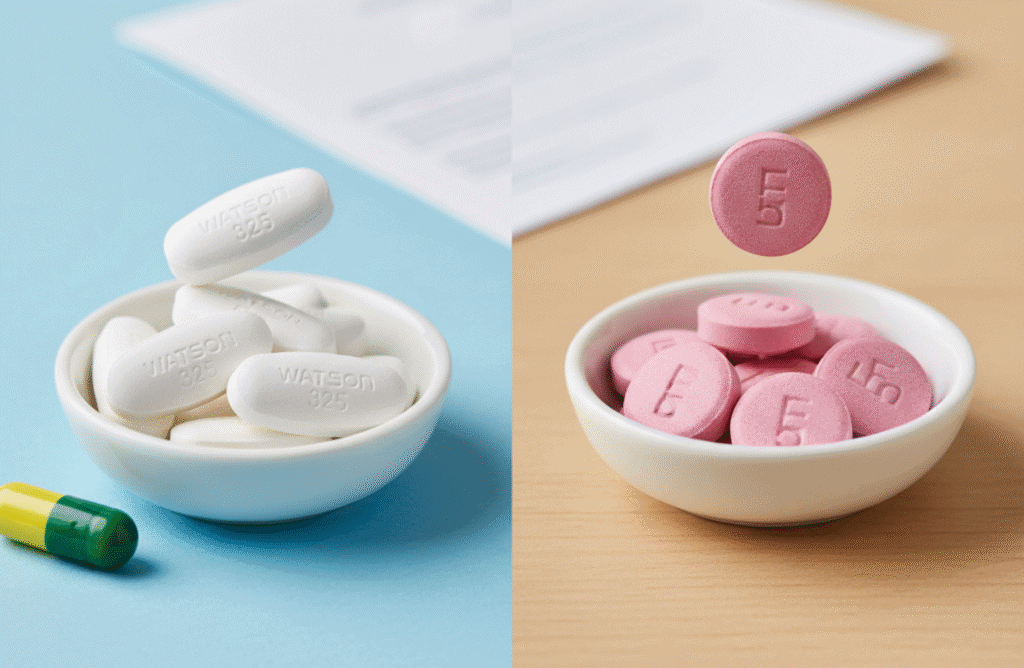
The most important distinction is the type of opioid in each medication. Vicodin contains hydrocodone, while Percocet contains oxycodone. Only oxycodone is considered more potent, which is why Percocet may be chosen for more intense or cancer-related pain. Vicodin, with hydrocodone, may be prescribed for acute pain or less severe cases of chronic pain.
Risks and side effects of Vicodin and Percocet
Like all opioid pain relievers, both Vicodin and Percocet can cause side effects that range from mild discomfort to life-threatening emergencies. Understanding these risks helps explain why doctors are cautious with these prescription pain medications.
Common side effects from Vicodin and Percocet, and other opioid medications
Some of the most common side effects of Vicodin and Percocet include:
- Drowsiness or dizziness.
- Constipation and nausea.
- Dry mouth and headaches.
- Low blood pressure or feeling lightheaded.
- Slower reaction times and fatigue.
Serious risks of opioid withdrawal
In addition to common side effects, these opioid drugs can also lead to serious problems such as:
- Slow breathing or shallow breathing, especially at high doses.
- Opioid overdose, which can cause unconsciousness or death if untreated.
- Organ failure from acetaminophen when taken in high amounts.
- Physical and psychological dependence, where the body and mind need the drug to function.
- Opioid withdrawal symptoms such as sweating, nausea, cravings, and anxiety when trying to stop.
Opioid overdose risk
The overdose risk is especially high if these medications are combined with other drugs such as benzodiazepines, alcohol, or sleep medications. In the event of overdose, emergency responders may need to administer naloxone to reverse the effects and save a life.
While Vicodin and Percocet can be effective for pain relief, their risks highlight why careful monitoring, exact dosing, and awareness of side effects are so important.

The role of controlled trials in understanding opioids
The safety and effectiveness of prescription opioids such as Vicodin and Percocet have been studied in many types of research, including controlled trials. These studies help doctors understand not only how well the medications support pain relief, but also the risks of dependence, misuse, and side effects.
Blind randomized controlled trials
In a blind randomized controlled trial, participants may receive either Vicodin and Percocet or other medications without knowing which one they are taking. This allows researchers to compare how the two drugs perform in managing acute pain or chronic pain while removing bias.
Double blind randomized controlled trials
In a double blind randomized controlled trial, neither the participants nor the researchers know which drug is being given. This is considered the gold standard for testing analgesic efficacy because it reduces the chance of expectation shaping the outcome.
Such studies have shown that both oxycodone and both hydrocodone can be effective for moderate to severe pain, though each comes with risks.
What controlled trials reveal
Evidence from double blind comparative trials and other research shows that while both Vicodin and both Percocet are effective opioid pain medications, the risks of opioid abuse, opioid dependence, and opioid use disorder are real. These trials help balance the benefits of short-term pain relief with the dangers of long-term use, high doses, and misuse.
Controlled studies reinforce the importance of using these prescription pain medications cautiously, at the effective dose, and only under a doctor’s supervision.
Treatment and recovery options for opioid addiction
The risks of Vicodin and Percocet show why it is so important to recognize the signs of opioid abuse and seek help early. Even though these medications are prescription opioids, they can still lead to serious problems such as opioid use disorder, opioid dependence, and long-term harm. The good news is that recovery is possible with the right care.
Medical treatment for opioid abuse
A doctor may recommend a medical detox program to help manage withdrawal symptoms safely. In some cases, medications are used to stabilize the central nervous system and reduce cravings. This reduces the risk of complications such as shallow breathing, low blood pressure, or relapse during early recovery.
Treatment and recovery options for those at higher risk
For those recovering from opioid dependence, treatment often involves a combination of medical support and structured therapy. Programs such as partial hospitalization (PHP), intensive outpatient (IOP), and standard outpatient care provide different levels of support depending on individual needs.
These approaches help people manage withdrawal symptoms, build coping skills, and address underlying emotional or behavioral challenges linked to opioid use.
Therapy and counseling
Addressing opioid addiction often means going beyond physical health. Therapy can help a person understand the underlying factors that led to substance abuse, such as mental disorders or unmanaged stress.
Group counseling and individual sessions offer tools to manage cravings, cope with triggers, and build healthier coping strategies.
Ongoing recovery support
Long-term recovery from opioid drugs like Vicodin and Percocet usually involves continued care. Support groups, safe monitoring, and lifestyle changes help people maintain progress and avoid relapse.
Recovery is not only about stopping prescription pain medication, but also about healing relationships, improving daily life, and addressing the underlying causes of pain and substance use.

Healing after Percocet and Vicodin misuse
The difference between Vicodin and Percocet comes down to their active ingredients. Vicodin contains hydrocodone, while Percocet contains oxycodone. Both are combined with acetaminophen and belong to the same class of opioid pain medications. While each can be effective for acute, chronic, or cancer-related pain, both carry the same risks of opioid dependence, opioid addiction, and opioid overdose when misused.
Recognizing the similarities and differences between Percocet and Vicodin helps people make safer, more informed decisions about pain management. Red Ribbon Recovery Colorado encourages individuals and families to stay informed about the risks of prescription opioids and to seek guidance when questions about use, safety, or recovery arise. For more information or support, contact Red Ribbon Recovery Colorado to learn about educational resources and community-based recovery options.
Sources
- Dydyk, A. M., Jain, N. K., & Gupta, M. (2025). Opioid use disorder: Evaluation and management. In StatPearls [Internet]. StatPearls Publishing. https://www.ncbi.nlm.nih.gov/books/NBK553166/
- U.S. Department of Labor. (n.d.). Risk factors for opioid misuse and overdose. https://www.dol.gov/agencies/owcp/opioids/riskfactors
- World Health Organization. (2023, August 9). Opioid overdose. https://www.who.int/news-room/fact-sheets/detail/opioid-overdose
- National Institute on Drug Abuse. (2024). Opioids. https://nida.nih.gov/research-topics/opioids
- National Academies of Sciences, Engineering, and Medicine, Health and Medicine Division, Board on Health Sciences Policy, & Committee on Pain Management and Regulatory Strategies to Address Prescription Opioid Abuse. (2017). Pain management and the opioid epidemic: Balancing societal and individual benefits and risks of prescription opioid use (Phillips, J. K., Ford, M. A., & Bonnie, R. J., Eds.). National Academies Press (US). https://www.ncbi.nlm.nih.gov/books/NBK458653/
- Marco, C. A., Plewa, M. C., Buderer, N., Black, C., & Roberts, A. (2005). Comparison of oxycodone and hydrocodone for the treatment of acute pain associated with fractures: A double-blind, randomized, controlled trial. Academic Emergency Medicine, 12(4), 282–288. https://doi.org/10.1197/j.aem.2004.12.005